



After the disapointing results achieved by the flawed british Garratts, some viewers may approach the Australian types with caution. The truth could not be further, in a remarkable twist, the articulated beasts were among the finest steam locomotives to operate in our borders, and indeed, rank among the greatest in the Garratt class when viewed on a global scale. (It is another example of how different Australia is compared to britain as an environment for trains to operate in. There is no 'given gurantee' with any type- be it conventional or unusual- that means it will operate well anywhere since each line and environment is different. An example of a design that, the reverse from the garratts, did well in Britain but was a disaster in Australia is the Fairlie, of which I will comment further in a later issue)
The first state I will cover is South Australia. SA needed no broad or standard gauge garratts, mainly thanks to the 'big-engine' policy of Commissioner Webb. However, the freight locomotives on the narrow gauge line between Broken hill and Port Pirie (T-class 4-8-0s from 1909) were being decimated by the heavy and long ore trains. An order was placed with Beyer Peacock for 10 oil fired narrow gauge garratts. Unusually, the order was subcontracted on to a french company, Societe Franco Belge de Materiel de Chemins de fer. This resulted in a dsign with more of a french-belgian influence on the appearance, particularily regarding the nameplate and buffer design.
The imported garratts arrived in 1953 and displaced the disliked '300 class Australian Standard Garratts' bought as a stop gap from WA. The new type was a versatile and reliable design, often working express passenger trains in addition to the heavy ore loads.
Above: The South Australian Railways 400 class Beyer-Garratt
The types were finally displaced by the new diesel electrics in the late sixties and by january 1970 all had been withdrawn. Fourtunately, two survive, both unfourtunately as static exhibits.
Victoria, like South Australia, had just one indigenous Garratt type: the G Class narrow gauge garratt. These two locomotives were used on the lines out of Moe and Colac, replacing the Na Class tank engines which were under serious strain from double heading and increased loads. Like the other AUstralian Garratts, they were constructed at Beyer Peacock and began service in 1926.
The two garratts proved their worth over their predecessors with significant savings in fuel and water, and the elimination of double heading.The narrow gauge lines they worked on, however, closed in 1954 (Moe) and 1962(Colac). The first locomotive, number G41 was scrapped, but the second, G42, is in full working order on the Puffing Billy Railway.
G42 in working order on the Puffing Billy Railway.
Because of the difficulty in getting afew of the details of the other garratts (most especially WAGR garratts) I will have to split this article up and post the third part once its done.
Saturday, March 15, 2008
The Mighty Garratts part 2: Aussie Edition-section 1


Saturday, March 1, 2008
The Mighty Garratts Part One: British Edition
The powerful Garratt style locomotive, basically two engines in one (not too disimlar to the Farilie arrangement) has been a valuable addition to many locomotive fleets of several countries. Many African nations (for example Rhodesia and South Africa) depended on the use of these designs well into the 1980s and '90s. Their ability to work well on tightly curving tracks and being able to haul very heavy trains over long distances and changing gradients has allowed the type to spread all over the globe, from Tanzania to Tasmania. Beyer Peacock (the company that never built an ugly locomotive) was the first to build a Garratt locomotive: the K1 for the North-East Dundas Tramway in Tasmania. This locomotive happily survives today in full working order on the Welsh Higland Railways.
Surprisngly, britain itself had used only two main-line standard gauge garratts: the LMS' 33 Beyer-Garratts, and the LNER's U1, designed by Sir Nigel Gresley and the most powerful steam locomotive ever to run in Britain.
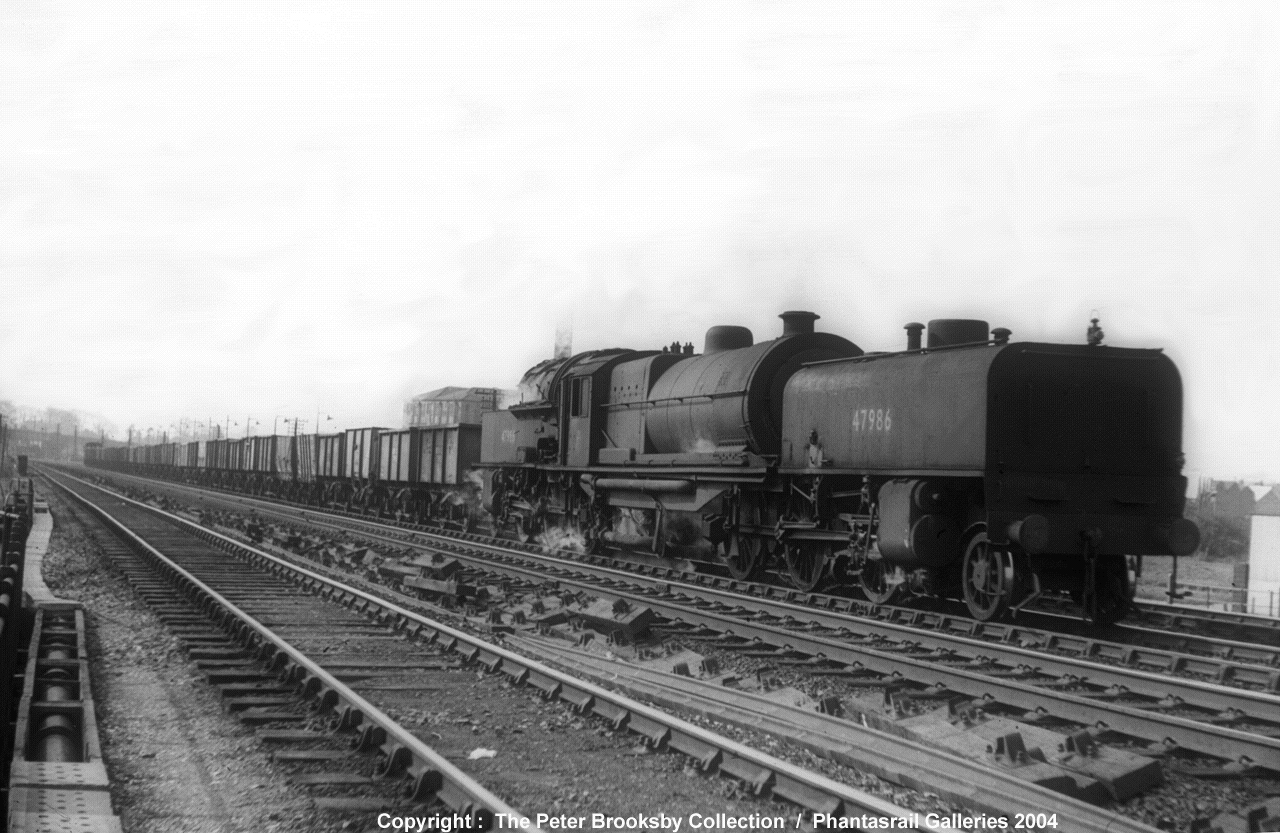
Top: the LMS Beyer Garratt in service and right: the LNER's powerful U1 in its official works portrait.
Both of these designs were plagued by two facts: one, that they were difficult to fire due to the lack of automatic coal pushers, and also, Britain's railways really were unsuitable grounds for them. Garratts are best deployed in difficult terrain or with exceptionally heavy loads, which makes them economically viable. There were certainly heavy loads, but the problame is they didn't materialse often enough- and to make matters worse, sidings and crossing loops for the extended trains were far too small. This is similar to what had occured with Nigel Gresley's excellent P1 design: it worked superbly, but the huge loads it was supposed to pull were rare.
The U1 was actually designed to bank coal trains over the steep Worsborough Bank on the famous Woodhead Route in its pre-electric days (reasons for it being known as the 'Wath Banker'). In its life it was converted to an oil burner with limited sucess, and was tried out on the Lickey Incline as a replacement for the legendary 'Big Bertha', however it was mostly unsuccessful. It was withdrawn and scrapped in 1955. Crews disliked the locomotive because of the massive amount of coal shoveling involved to keep it running, coupled with hellish breathing conditions created by the smoke it relased when banking in the Silkstone Tunnels. The garratt's crews were notorious for failing it for the slightest reason if it meant they wouldn't have to use the locomotive that day. Among other problems, it also suffered from excessive boiler corrosion due to the very soft water it was fueled with.
As for the 33 beyer-Garratts on the LMS, they suffered from a critical defect: they were designed according to the Midland's 'Small engines' policy- and had only standard axle boxes which suffered from critical overheating. Their coal consumption was terrible and like the LNER's U1 they were maintenance nightmares.
One good point about the LMS design was its revolving coal bunker on the later engines which made the fireman's lot much easier. However, there was still no automatic coal pusher.
So, the verdict for the two sole garratt designs to operationally serve in Britain? Both were flawed, and were in some ways uneccesary- the design was meant for curved and diffcult terrain with plenty of siding room for accomodating long trains- not what they operated on. Also, despite their power, the type should have been selected for use only with the heaviest and longest trains to make them economically viable. As it was, these trains were realitely few in those days (a problem shown, as mentioned, with the otherwise excellent P1 mikado of the LNER). However, for banking purposes, the design was also flawed. Such needs could have been met by a more conventional locomotive: for example in the style of the classic 0-10-0 'Big Bertha' wich was perfect for use on the sharp Lickey Incline.
Certainly, though, both designs did at least give the two operating companies some serious pulling might. the U1, as mentioned, gave its designer yet another record to add to his book: the most powerful British steam engine ever. The LMS design might well have been better had it not been for the restrictive loading gauge and the faulty axle boxes.
Despite the Garratt design's failure to become entrenched in British Steam annals, it acheived great success on another continent where there was the space, heavy train loads and terrain that meant the type could achieve success. In the next part, I will talk about, of course, the Australian Garratts and their excellent, far more lasting service.

Wednesday, February 20, 2008
The Galloping Sausage

(source:LNER Encyclopedia)
The only 4-6-4 tender engine to run in Great Britain, Hush-Hush was the result of Gresley's experiments with high pressure water tube boilers, similar in type to those used in ships. The use of this boiler in a steam locomotive was not new, a number of others had been built by others (an American Company was the first), however this was the first time anybody had made an express-type locomotive to haul passenger services. Gresley's main reason for experimenting with the water-tube boiler stemmed from his wish to find a method of reducing coal consumption and a more efficient way of generating steam. At the time, the A1 Pacifics (not yet modified into the classic A3 model).
The locomotive was nick-named 'Hush-Hush' because of the secrecy of the project (although it is well known that probably everybody at Doncaster knew of its existence). Entering service in late 1929, the W1 ran around 90000 miles over the next six years, although a lot of time was spent fixing problems- out of the 1,888 days since it was built, No. 10000 spent 1,105 days in Darlington Works.
Gresley decided to re-build Hush-Hush as a conventional locomotive with streamlining in the style of an A4. In hindsight, this as probably an even wiser idea than it seems on first impression: with World War Two only a few years away, the unre-built locomotive would have been laid up with repairs for almost all the war years: during wartime, the standard of locomotive maintenece dropped off radically, and Hush-Hush required a lot of maintenance to keep it running.
As it was, the new locomotive resembled a larger and nameless A4. It was soon realised no.10000 was probably one of the strongest passenger locmotives in Britain: having an amazing 16% power incease over the already strong A4s. It gave excellent service on the heaviest passenger trains over the next twenty years (although little of its wartime use has been recorded apart from causing a few maintenance problems).
Surprisingly this one-off locomotive survived the early cuts of nationalistaion (among the casualties of standardisation were Bulleid's Leader and Stanier's Turbomotive, although it was rebuilt as a conventional locomotive). Somewhat more surprising was that it was passed over by Gresley's succesor, Edward Thompson for experimenting- given that most of Gresley's non-standard classes like the P2s were rebuilt into pacific styles or scrapped like the P1s.
No.10000 (renumbered 60700 in BR ownership) lasted until 1959, when it was finally cut up.
Was Hush-Hush a sucess? The answer is somewhat difficult to decide, much like the controversial 'Leader' design. Certainly no.10000 worked, and was recorded as being strong in both re-built and un-rebuilt form. As a more conventional locomotive it hauled revenue-earning trains for twenty years with a strong success rate. The unusual water-tube boiler did (after some modification) give good steam-raising and decent coal-consumption. The addition of a Kychlap exhaust on a recommendation from legendary French steam designer Andre Chapelon further increased its potency.
The downside: maintence took up most of its time, downplaying any costs saved in fueling. Also the unconventional boiler could not be easily fixed by normal loco works neccesitating use of Darlington works and further clogging up the maintenance schedules of the LNER. Also, there would be little use of a 4-6-4 tender engine like Hush-Hush except on long-distance passenger trains or frieght where the lack of continuous stopping and starting would keep the fuel efficiency high.
Had Hush-Hush been given more time it might well had succeeded further. But there would have been no way for Gresley to experiment in World War 2, and on his death in 1941 Thompson would have felled the unconventional type anyway. Nevertheless, it must surely rank as one of the more successful designs: if only because its rebuilt form lasted long enough to earn back the time and money spent in Darlington Works.
Tuesday, February 19, 2008
Love the LNER
Firstly, an examination of what makes the LNER (London & North Eastern Railway) locomotives more attractive for myself and others than say the LMS or the mighty locos of the GWR or the Bullied Pacifics of the Southern.
The LNER hosted some of the most attractive and successful locomotives that have seen service anywhere, some still in operation. The designers (Gresley, Thompson and Peppercorn) gave us marvellous designs like the A1/A3, the P2, the A4, V2, A2, B1, N2...names like Mallard, Flying Scotsman, Mayflower, Green Arrow, Blue Peter that linger on in the memory. And who could fail to be charmed by their first glance of 4472?
OF course, the same can be said for the other railways in the 'big four'. Indeed, they too have their own strengths/weaknesses as does the LNER. Despite this blog being biased towards the LNER, I am also happy to praise the other lines and some of their marvellous vehicles as well. 'Kings' to 'Royal Scots'. Oliver Bulleid (look! I spelt it right) in particular is a favourite of mine thanks to his innovativeness, viz the Q1 and the 'Leader'.
Australia wise, I don't have a particular bias, but South Australia definately has some of my favorites: the Amercian designer Webb brought us some massively powerful 520 4-8-4s that looked good too...although NSW had some mighty Garratts..
Greetings! Welcome to the Line
Hi everybody: welcome to the Rail blog of Klink from Australia.
In this blog, I'll talk about everyting rail-related: most specifically on British and Australian sources. You'll read treatises on locmotives, designers, comparisons of the 'big-four', pre- and post-nationalisation railways, the Beeching Axe, modern british lines, Australian steam and diesel devleopment, state-to-state rail rivalry (for you british, each state had its own gauge up tll about twenty years ago: broad, standard or even narrow for queensland...), stories from Australian lines..
Railfans, feel free to add your opinions/ ideas and add-ons to my thoughts.
