EDIT! Updated 26th APRIL, with new information! See bottom of this article for links to all the pertinent websites of each project.
No matter how much lovers of the steam age wish otherwise, there are a multitude of locomotive classes that have disappeared from the rails seemingly forever. To name a few, from the Southern we lost Maunsell’s W and Z classes, Urie’s H15 and Drummond’s D15, just to pick random types. Nigel Gresley and the other LNER designers have fared the worst in terms of preservation, since many classes have only one representing them despite their considerable fame and excellent service; examples being Gresley’s A3, N2, K4 and V2. Just 11 Gresley engines have survived, sad compared with the many Stainer/Churchward/Collett/Bullied engines which have lived on. Arthur Peppercorn has just two remaining engines: the A2 Blue Peter, and the K1 no.2005. Edward Thompson has only a single design remaining, the B1, of which two have survived. The low number of LNER survivors has been blamed on the fact that only one engine (one of the B1s) was sent to Dai Woodham’s Barry Scrap yard.
However, the audacity and daring of the preservation movement knows no bounds, and thus the opportunity to see at least some of the lost engines reborn has come. After 18 years and 3 million pounds of finance, the first ever new build for mainline steam, a Peppercorn A1, Tornado, is finally finished, and has been broken in on both the main line and in the Great Central Railway- nearly 7000 visitors flocked to see Tornado along with Oliver Cromwell and other famous engines at a GCR gala in late 2008.
UPDATE!!! TORNADO IS COMPLETED. The engine was officially named by HRH Prince of Wales and the Duchess of Cornwall on 19th of February in a delightful ceremony- and on the 18th of April, Tornado hauled the Yorkshire Pullman out of King's Cross- the first time an A1 has done so in over 40 years!
Tornado is far from the only reborn class. Incredibly, over one hundred thousand pounds have by now been pledged to another project: an original LMS ‘Patriot’. Basically a small-boilered version of the ‘Royal Scots’ (hence the ‘Baby Scot’ nickname), the type was built by Fowler (and some later rebuilt by Stanier, although the new-build will be of the original form), but were withdrawn from service in the 60s too early to be saved by the preservation movement. Already progress is being made: the axle boxes are being lifted from an‘8F’ which has not been restored. In keeping with the convention of naming the class after war-related topics, the new engine will be officially called ‘The Unknown Warrior’ as a special tribute to those who lost their lives in combat. The 'frames appeal' was launched 19th April.
UPDATE!! The website lists the frames as having been already cut at Corus Workshops, but no further information is avaliable. However, interesting news has been released- the Royal British Legion has fully endorsed 'The Unknown Warrior' as the new national Memorial Engine.
Meanwhile, the Great Western Society at Didcot Railway Centre is proceeding with two magnificent projects of their own. The first is one of the more unusual in that it is a restoration rather than a new-build: Steam Railmotor No. 93 and Auto Trailer No. 92. Already a new vertical boiler has been built and brought to Didcot for the Railmotor, cylinder blocks and a new power have all been completed. As for the auto trailer, restoration of the paneling is well underway with both vehicles now at the Llangollen Railway for the construction.
UPDATE!! As of 12 March, one of the major steps has been completed: the 101 year old wooden coach body has been reunited with its underframe. An experimental fitting of the power bogie, coal bunker and boiler has also been carried out.
The second project? A recreation of a Hawksworth ‘County’. The boiler from the same ‘8F’ that donated its axle boxes for the Patriot is being converted into a proper GWR boiler for the new locomotive. The locomotive is a recreation of County no 1014, ‘County of Glamorgan.’
That is not the only GWR tender engine being re-created! Another lost class, the ‘Grange’, is being restored also: no 6880 ‘Betton Grange’ will be the 81st of its class once completed. As of yet, the boiler and cab have been completed, with attention now focusing on the frames.
UPDATES!!! The 'County' continues to progress- as of March, the running late is being marked out for riveting, and the bogie axlebox springs have been delivered. Unfourtunatly, progess during March was constrained by funding issues.
The 'Grange' as of October, has both rubbing plates (where the tender buffers against the engine) fitted, rear buffer beam fully fitted, with slots cut out, the front saddle plate fitted, saddle plate angle fabricated, four angles cut and fitted below cab, and four other angles fitted to hold the buffer beam and saddle plate. In Feburary, the bogie wheels were being tested, and the side brackets are being machined.
NEWS FLASH! A THIRD PROJECT!
A GWR 4-6-0 'Saint' is being built out of a Hall Class locomotive No 4942 “Maindy Hall” back to a Saint )"2999", 'Lady of Legend'), just as it would have been around 1913. As of August it is not far away from completion, with work being done on the fittings and painting the engine! No further information added as of April '09.
Two BR standards are also underway. One of them, a new ‘Clan’ Pacific, Hengist, I have already described in the previous post. The other is a Riddles 3MT 2-6-2 82000 Class. No. 82045 has as far, progressed quite well: drilling of the frames has commenced at the Severn Valley Railway, although finance is a problem given the desperate need the SVR has for funds to repair flood damage from last year’s terrible washouts. However, upon the completion of the 3MT, the group (The 82045 Locomotive Fund) is actually looking to construct more of the same type for use on heritage railways! This would drastically lower the price involved in building the 82000s and allow the possibility to recreate another lost Standard class: the Class 3 77000 mogul. This is an interesting and very unusual scheme: the idea is that these new standard classes will be used extensively on heritage lines to allow preserved railways the chance to relieve pressure on their other rolling stock. This will allow the various lines to save on maintenance on their existing locomotives (and maintaining/servicing steam engines is not cheap). The Bluebell Railway is also converting one of their 2MT 2-6-0 Tender engines into a 2MT 2-6-2T, mainly because the original loco currently lacks a tender, and the Bluebell railway prefers the use of Tank locomotives.
UPDATES!!! Progress has been made on 'Hengist's smokebox by the South Devon Railway, and the ejector exhaust elbow has been completed. As of April, machine work on 82045 is continuing-the firebox support bracket has been completed. The Bluebell's 2MT tank has had its main extension plates drilled.
But it is not only late-period locomotives that are being constructed. The Bluebell Railway has come very close to finishing a recreation of a locomotive that was cut up at Eastleigh just before the preservation society was formed: the Brighton H2 Atlantic ‘Beachy Head’. Incredible as it may seem, no. 32424 is not so far away from completion! As of March 2008, the main frames have been finished: this means that the locomotive can essentially be said to ‘exist’ again!
UPDATES!!! As of 9th April, water cutting of the Motion parts has begun.
Another old type to be reborn is the North Eastern’s O class (better known by LNER’s designation ‘G5’). Again, this small 0-4-4 tank is being rebuilt with service on the small preservation lines. As of April 2008, the boiler and firebox are on order for construction.
UPDATE- News finally! Quote from their post detailing the construction at Great Northern Steam in Darlington: 'The bogie-frames are near to completion and the bogie, minus wheels & axles should be fully assembled for Christmas 2008.'
STOP PRESS! ANOTHER TWO NEW BUILDS!!
Mentioned earlier in the lack of Gresley types remaining in preservation. One of the most keenly missed was the B17 4-6-0, best known as the 'Sandringhams' or 'Footballers'. What is amazing about the project to rebuild this class is that not one- but TWO!! are planned. One of them will be mainline capable and fully operational, and the other will be a static exhibit. The society is so far progressing well, with the B17 cab ready for painting. An order has been placed for a GER-style tender frame.
LATEST NEWS: APRIL 09: nothing about the engine, but the society had a popular appearance at the Barrow Hill 'LNER Gala' recently. Comparisons have been made between the first LNER new-build (Tornado) and this project, and the society is attempting to live up to the expectations created by the A1 Steam Trust's fine work.
A second new build project is a surprising one- a replica LNWR 'Bloomer'- that is actually not too far off completion! Although the project is relatively quiet, work continues at Tyseley Locomotive Works.
NEW ADDITION! 26th April
As described in a recent post, a replica of a Midland South Western Junction Railway Beyer Peacock 2-6-0, nicknamed 'Galloping Gertie', is a new project launched recently. Currently the engine has no parts yet, the group behind it is still in the stages of planning and publicity. Australian enthusiasts should be extra interested since the planned engine is almost a clone of a design used on our railways bar two differences. We wish them the best! (link at the bottom of the page)
Despite their expense and the amount of time/effort they eat up, the new-builds are really a massive part of the future of the steam preservation movement, at least in Britain. There are really no other forms of transport (air, cars, ships) that can boast a massive movement to return long-gone classes/examples to use. The public interest/media coverage given to the remarkable rebirth of steam locomotives all over (one should look merely at Tornado's publicity) is wonderful and bode nothing but good for future projects.
Perhaps, with some luck, Australian preservation groups might be able to find the funds and time to produce some of our own lost types, although this will remain a pipe dream while existing engines need repairs and restoration.
UPDATE!!! Here are the Links to the various websites:
A1 Steam Trust
Patriot Project
County Project
Betton Grange Trust
Hengist Trust
Railmotor no 93
GWR 'Saint'
B17 Project
LNWR Bloomer
Bluebell Railway 'Beachy Head'
Bluebell Railway 2MT Project
Riddles 3MT Fund
G5 Group
MSWJR 'Galloping Gertie'
Tuesday, May 13, 2008
Other British New Builds!
Friday, April 25, 2008
Standard Class 6 'Clan' pacifics
‘Clan Pacific’
The BR Standardization program following nationalization was highly controversial to say the least. Many people who hailed from the GWR, Southern or LNER were unhappy with the level of LMS influence on all the new types and the ignoring of the designs of the engineers Bullied, Peppercorn and Hawksworth, particularly as the latter two had only had the job of locomotive superintendent for a few years. Indeed, despite the success of Bullied’s pacifics, Peppercorn’s three designs and Hawksworth’s ‘Modified Halls’, these were overshadowed by the supposedly more modern and less complex tanks and tender moguls of Ivatt on the LMS. The fact was that the complex oil-driven chain baths of Bullied’s Pacifics, the LNER complex 3-cylinder designs, and the lack of innovation in GWR practice were unattractive for a standard, all-routes design theory.
However, BR did not follow its own standardization practice, that is no building of superfluous locomotives or experimentation. An example of this was the prevention of Riddles building the Standard 8P Pacific design (a more powerful version of the ‘Britannias’) due to the large number of ex-LMS/LNER pacifics operating, even though many of these were either worn out and in need of repair work, or machines that did not fit in with the ‘ease-of-maintenance’ Standardization program (case in point: Gresley’s 3-cylinder pacifics, whose 3rd-cylinder with its conjugated valve gear was complex and required careful attention. Also, the Railway Executive was also biased against 3-cylinder designs which shows up in the fact that all but one Standard class had two cylinders.). The sole member of the class was constructed only after the Princess Coronation-class pacific, Princess Anne, was destroyed in the terrible triple collision at Harrow and Wealdstone. (The resulting engine, Duke of Gloucester, was doomed thanks to errors made in construction, among them the fitting of a normal chimney compared to the preferred Klychap exhaust. A poor performer in BR service, it was happily rescued from the scrap-head by preservationists who during rebuilding corrected the errors made. The result was one of the finest express locomotives ever seen, and still a great performer on heritage main-line services).
Despite the lack of tolerance towards mavericks, BR still gave permission for Riddles to construct just ten members of the smaller version of the ‘Britannias’ for service on lighter branch lines along wider route availability. The new design: christened the Standard Class 6 Light pacific, was given the more commonly known title of ‘Clan’ Pacific.
Considering the emphasis on ‘economy’ by British Railways for its new designs, it seems a strange decision to make such a small number which did not match the other designs and would hence cause bottlenecks in part availability. This can be partially explained; originally 25 locomotives were planned, however due to the shortage of steel in Britain at the time the second batch of fifteen were continually postponed until they were cancelled in the wake of the infamous ‘Modernisation Plan’ of 1955. (Co-incidentally, there was a second superfluous group of engines was constructed that BR would have been better off either expanding or leaving alone: the BR standard class 3 2-6-0, of which only 20 were built). The small number of locomotives prevented effective training of personnel, which led to problems when a ‘Clan’ was sent to areas other than where the enginemen and support crews were familiar with them. (It must be added that many locomotive crews had a bias against the new ‘standards’ which replaced their old types from the ‘Big Four’, especially those crews who were from the GWR/LNER/Southern since the standards had an overwhelming LMS influence to them).
To make matters worse the design was not given time for its various bugs and defects to be worked out, due to the demand for a light pacific on the main lines in the West of Scotland. The main problem, which would have been ironed out if Riddles had been given the chance to modify the design (this was prevented by the Modernisation Plan of 1955, once again), was the fitting of a blast pipe too small to allow good airflow, and a single chimney rather than a double. Many drivers complained of a lack of pulling power, which can partially be explained by the unfamiliarity of many crews with the type, but certainly the rushed construction was mostly to blame.
Despite these problems, the ‘Clans’ could be excellent machines when handled properly, and were found useful when used in areas such as the Midlands and on heavy Scottish boat trains. The class even holds a record that is very unique: a member of the type was the only ‘pacific’ locomotive to ever run on the West Highland Line, in a successful test to see if a 4-6-2 could manage the tightly graded/curving line. They were also tried in services on the eastern region until dieselization forced them into secondary duties. However, their reputation was tarnished by an error which accidentally had them working heavier Class 7P duties (which they were unable to keep to due to their lower 6P rating) which caused missed timetables and a shift of 7P/8P pacifics to replace them there.
Like the other BR standards, the type had hopelessly un-economic lives, the oldest surviving a mere 14 years, all being scrapped by 1966. The second batch had been cancelled well before, but part of the frames for the first of the new 15, to be named ‘Hengist’ had been completed but stopped due to the steel shortage.
The class has never lost its reputation of being a failure even though it did have many successes, probably stemming from the multitude of complaints received about the many troubles. There is little doubt however that the construction of a mere 10 engines was a tremendous waste of development money given that they were never multiplied upon and were not modified to give better service as Riddles intended. However, the ‘Clans’ were easy to maintain, all-purpose given their lighter weight and smaller size and excellent performers when treated with care. Overall, they can be classed as a success, but were not without their problems.
Although none of the class survived, thanks to the miracle of ‘new-build’ projects, what would have been the first of the next batch of 15 engines is well underway at the East Somerset Railway. Depending on whether it beats the new-build Standard Class 3 2-6-2T into service, ‘Hengist’ will be the 1000 steam locomotive to be built to a BR standard design. More importantly, given the modifications that will be added to bring the class up to Riddles’ original intentions, the ‘Clan’ pacific may well undergo a redemption in reputation not unlike that of the similarly maligned Duke of Gloucester.

Tuesday, April 15, 2008
The Mighty Garratts: Aussie Edition Part Two
Finally, the last of my garratt pieces!
First off, we'll start with Tasmania.
INfamously, the worlds first Garratt was ordered from Beyer Peacock in 1909 for the North-East Dundas Tramway in Tasmania. This narrow-gauge line, long vanished, is survived by one of the historic K CLass Garratts, K1, currently in working order on the Welsh Highland Railway in Wales! (the second was scrapped and its psrts used to rebuild K1). The 0-4-0+0-4-0 were different from the later garratt standard, in that they had compounding and cylinders facing inboard. Compared to later Garratts they were tiny, but the clear roots of ancestry are still present, and the type's success prompted its widespread dissemination.
Above: K1 on the Welsh Highland Railway.
Two others were used on Tasmania's narrow gauge lines. Sadly neither of these types have survived, regretable considering their historical significance but the same could be said of hundreds of other locomotives lost all over the world.
The first type, from 1912, is unusual in that it was designed for passenger working, which is not usually a duty Garratts are made for. The M Class had a 'double atlantic' wheel arrangement, (4-4-2+2-4-4). The class gained noterity when it broke the speed record for an articulated locomotive at 85km/h (53mph). This would be impressive even for a regular type on a narrow gauge track. Thanks to their performance, the class worked the main line between Launceston and Hobart, until 1930when they were replaced by conventional types. As stated, all members of the class were scrapped.
Above:The M Class on a special Excursion train
The other design was ordered at the same time as the M, two frieght-hauling Garratts of the 2-6-2+2-6-2 type. Designated L class, they succesllfully worked the main line between Launceston and Hobart's goods services, helped by the fact they had a tractive effort (30170 lb) that made them the most powerful narrow gauge engines then in use. Despite their small driving wheels they were sometimes scheduled on passenger workings and were surprisingly suited in this role. Although they too were mothballed in 1930, they were not scrapped, and saw a brief return to work in the dark days of World War Two. Once again, they were tragically scrapped, leaving K1 as the sole-surviving Tasmanian Garratt.
Above: The L Class near its last days in 1944/45
Tasmania briefly used the Australian Standard Garratt during World War Two, and ironcially they were the only state to get them to work relatively succesfully, and only after heavy modification.
QUEENSLAND had just one indigenous Garratt type (they also used the infamous Australian Standard Garratt or ASG), known only as 'Beyer Garratt'. These were the most powerful steam locomotives ever used on Queensland Railways, unsurprisingly. Ordered in 1950, 30 of these 4-8-2+2-8-4s were constructed, 20 by Franco-Belge and the rest by Beyer Peacock. Painted red, they were assigned to passenger and freight services around Rockhampton initially before dispersal. Restrictions had to be imposed on their use, however, after enginemen complained of excessive heat and smoke in tunnels, not surprisngly. Like South Australia's Garratts, their role was taken over by diesels, shifting their base of use to the heavy coal fields in the Dawson Valley. They had a short working life, removed from the railways between 1964 and 1970. Happily, one survives at Redbank Museum. It was restored o working order in 1995 and now works heritage specials.
ABOVE: Queensland's surviving Beyer Garratt, in full working order.
WESTERN AUSTRALIA experienced outstanding success with its' first Garratt design, the 1912 M Class (later Ms with superheating added). These 2-6-0+0-6-2s were employed on light passenger operations, and their performance prompted, in 1930, the Western Australia Government Railways to build what was perhaps the first Garratt originating in the Southern Hemisphere (certainly it was the first built in Australia). Titled 'Msa', these had a higher tractive effort and were hence deployed on some of the more hilly portions of the various lines. The original locomotives had been withdrawn by the end of the 1940s but the Msa class continued to almost the end of steam.
Above: The original M Class Garratt
Sadly, despite the M/Ms/Msa's importance and success not a single example from any other types has survived. A tragic loss of a fine type that by all means should be worthy of a new-build program if an Australian version of the 'Tornado' project should ever be considered.
Above: the superheated Ms class
Now, WAGR had one other type of Garratt that is remembered as being the only true Garratt faliure in Australia...and a spectacular faliure at that. During the Second World War in 1943, the Commenwealth Transport Board attempted to build a Garratt design to solve narrow-gauge bottlenecks. 65 were ordered- to an untried design with low axle load and high haulage abilty. Only 57 were completed in 1945 before the rest were cancelled.
The Australian Standard Garratt (ASG)4-8-2+2-8-4 was the type, and it was plagued by difficulty, mishaps and black-bans by enginemen. WA even subjected them to a Royal Commission! Most were gotten rid of as soon as Diesels were avaliable, sold off to private companies and a few were sold to SAR who were awaiting their own Garratts from Franco-Belge.
ABOVE: The disasterous Australian Standard Garratt.
Unsurprisingly, only one has survived, and that solitary example was sold to a Geelong Quarry who in turn sold it to the Geelong Steam Preservation Society, who restored G33 to working order.
The very last Garratt I will descirbe is from NEW SOUTH WALES.. and is undoubtably the most powerful and largest of them all. The mighty AD60 is Australia's strongest steam engine and one of the world's largest Garratt types, nearly equalling some of the African types in size.
ABOVE: Australia's steam giant, the AD60.
42 of them were acquired in 1952, intended to haul coal over the Blue Mountains. However, their surprisngly light axle load allowed them to be used all over the NSW system on all manner of duties from heavy wheat trains to light goods. Throughout their careers they were modified as a result of input from enginemen and from experience.
Diesel influxes started to cut into their duties early, but the type lingered on throughout the 1960s until final withdrawls occured in 1970. Thankfully, no less than four examples of this fine design survive:6029 by the ARHS Canberra, 6039 and 6042 by the Dorrigo Steam Railway and Museum and 6040 by the NSWRTM at Thirlmere. Unfortunately, none of these is in working order, but perhaps in future one will be restored for heritage excursions.
The success of the Garratt design in Australia, and its realtive faliure in Britain contrasts sharply with that of another similar design, the Fairlie, which will be discussed at a later date. It is an interesting lesson that no matter how well thought out a design is, if it is in an unsuitable role or location it will not succeed. It cannot be stressed enough the importance of the type on steam locomotive development and transporting vast amounts of material, and certainly, in the impact they have had upon the development of Australia as a whole.


Tuesday, April 8, 2008
Return of the Peppercorns...
Again a delay on Garratts part 2, but this time for a marvellous reason.
This month's (in Australia that is, in the UK it was the february edition) Steam Railway had the most wonderful news you could have hoped for: after 18 long years of waiting and 3 million pounds of finance, the 51st Peppercorn A1 pacific, the first main line steam engine built in Britan for over 40 years, has officialy raised steam.
This means that it will be only a short time before, at last, the locomotive is ready to begin its revenue-hauling first trains. By all accounts these will be on the Great Central Railway.
Although the mere act of raising the fire in the Tornado is significant in itself, it also has more wide-reaching effects: the critics who said it could not be done have been silenced, and encouragement has been given to the other 'new-build' projects: the 'County' and 'Patriot' remakes among them.
Ironically, this is only the second Peppercorn pacific to be still in existence, the other being the famous A2, Blue Peter.
here is the official website with some more recent news:
http://www.a1steam.com/index.php?option=com_content&view=category&layout=blog&id=1&Itemid=123
Friday, March 28, 2008
Intermission- Fatal Crashes
I know most of you are expecting the next lot of garratts but I felt the need to deviate to a more serious subject.
Over the past year there has been an abnormal mumber of deadly collisions on our rail networks. All of them have been the fault of incoming vehicles either ignoring the level crossing and proceeding straight through, foolishly driving on the railroad tracks (this occured in a recent crash at Monarto here in SA, fortunately no one was killed) or not keeping a lookout for trains.
Last week the latest fatality occured in Victoria, involving a family returning from Easter holiday who did not see the train coming and did not stop. Immediately there has been calls for flashing lights and full crossing gear to be fitted to every level crossing in Victoria, regardless of isolation. Not only is this expensive, it would be in many areas a waste of time given that in some places trains may only run once or twice every couple of weeks. The Victorian transport minister has called for councils to close areas of road crossing such zones. This is impractial- the roads must surely be used by some people- and will the government fork out extra cash to build replacemtns? Unlikely.
What is needed tis the tightening of laws concerning unguarded level crossings- even though this is common sense, ALWAYS stop the car, look both ways- if there is a train coming AT ANY DISTANCE do not proceed- one remebers a bus getting stuck in the tracks at Salisbury Station and the resulting collision killing several schoolchildren and injuring others.
As long as drivers believe that they can ignore the signs and foolishly zip through level crossings in the country there will continually be accidents.
Saturday, March 15, 2008
The Mighty Garratts part 2: Aussie Edition-section 1
After the disapointing results achieved by the flawed british Garratts, some viewers may approach the Australian types with caution. The truth could not be further, in a remarkable twist, the articulated beasts were among the finest steam locomotives to operate in our borders, and indeed, rank among the greatest in the Garratt class when viewed on a global scale. (It is another example of how different Australia is compared to britain as an environment for trains to operate in. There is no 'given gurantee' with any type- be it conventional or unusual- that means it will operate well anywhere since each line and environment is different. An example of a design that, the reverse from the garratts, did well in Britain but was a disaster in Australia is the Fairlie, of which I will comment further in a later issue)
The first state I will cover is South Australia. SA needed no broad or standard gauge garratts, mainly thanks to the 'big-engine' policy of Commissioner Webb. However, the freight locomotives on the narrow gauge line between Broken hill and Port Pirie (T-class 4-8-0s from 1909) were being decimated by the heavy and long ore trains. An order was placed with Beyer Peacock for 10 oil fired narrow gauge garratts. Unusually, the order was subcontracted on to a french company, Societe Franco Belge de Materiel de Chemins de fer. This resulted in a dsign with more of a french-belgian influence on the appearance, particularily regarding the nameplate and buffer design.
The imported garratts arrived in 1953 and displaced the disliked '300 class Australian Standard Garratts' bought as a stop gap from WA. The new type was a versatile and reliable design, often working express passenger trains in addition to the heavy ore loads.
Above: The South Australian Railways 400 class Beyer-Garratt
The types were finally displaced by the new diesel electrics in the late sixties and by january 1970 all had been withdrawn. Fourtunately, two survive, both unfourtunately as static exhibits.
Victoria, like South Australia, had just one indigenous Garratt type: the G Class narrow gauge garratt. These two locomotives were used on the lines out of Moe and Colac, replacing the Na Class tank engines which were under serious strain from double heading and increased loads. Like the other AUstralian Garratts, they were constructed at Beyer Peacock and began service in 1926.
The two garratts proved their worth over their predecessors with significant savings in fuel and water, and the elimination of double heading.The narrow gauge lines they worked on, however, closed in 1954 (Moe) and 1962(Colac). The first locomotive, number G41 was scrapped, but the second, G42, is in full working order on the Puffing Billy Railway.
G42 in working order on the Puffing Billy Railway.
Because of the difficulty in getting afew of the details of the other garratts (most especially WAGR garratts) I will have to split this article up and post the third part once its done.


Saturday, March 1, 2008
The Mighty Garratts Part One: British Edition
The powerful Garratt style locomotive, basically two engines in one (not too disimlar to the Farilie arrangement) has been a valuable addition to many locomotive fleets of several countries. Many African nations (for example Rhodesia and South Africa) depended on the use of these designs well into the 1980s and '90s. Their ability to work well on tightly curving tracks and being able to haul very heavy trains over long distances and changing gradients has allowed the type to spread all over the globe, from Tanzania to Tasmania. Beyer Peacock (the company that never built an ugly locomotive) was the first to build a Garratt locomotive: the K1 for the North-East Dundas Tramway in Tasmania. This locomotive happily survives today in full working order on the Welsh Higland Railways.
Surprisngly, britain itself had used only two main-line standard gauge garratts: the LMS' 33 Beyer-Garratts, and the LNER's U1, designed by Sir Nigel Gresley and the most powerful steam locomotive ever to run in Britain.
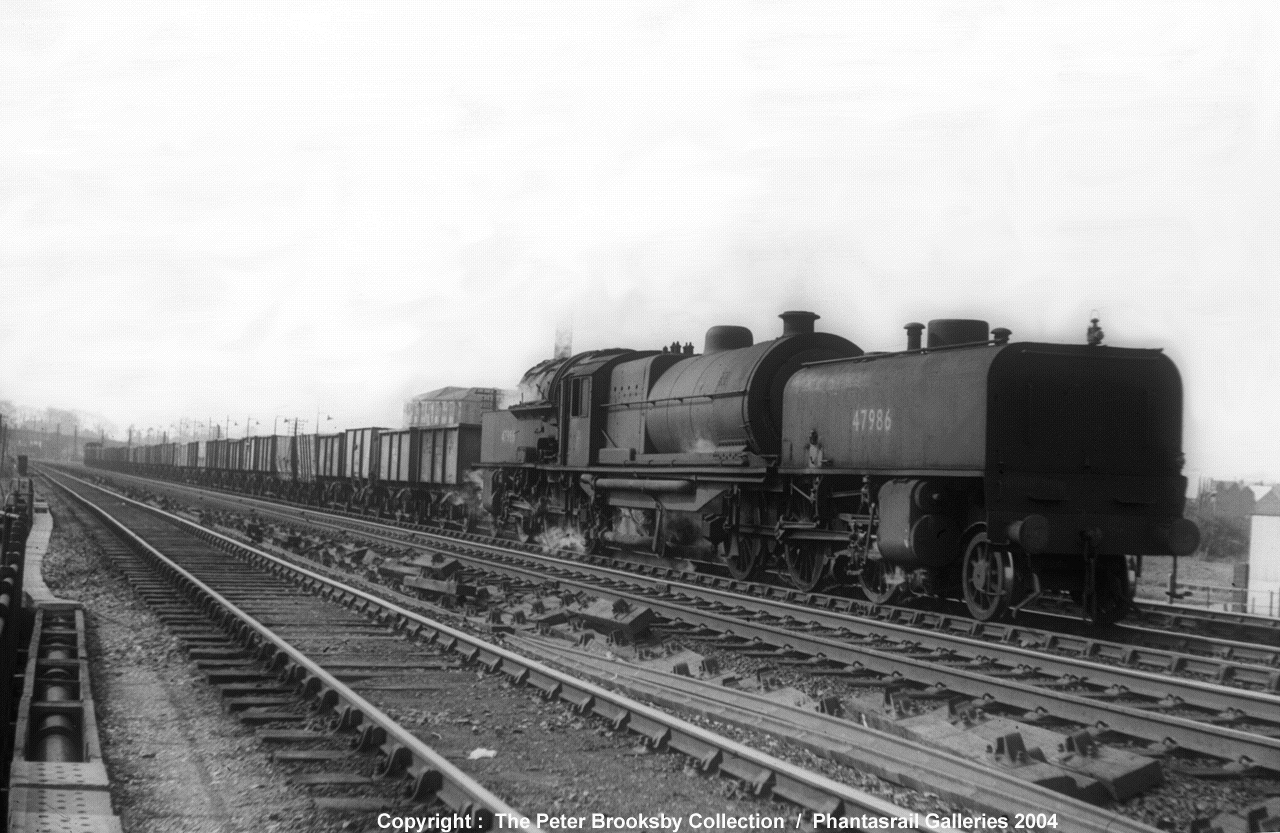
Top: the LMS Beyer Garratt in service and right: the LNER's powerful U1 in its official works portrait.
Both of these designs were plagued by two facts: one, that they were difficult to fire due to the lack of automatic coal pushers, and also, Britain's railways really were unsuitable grounds for them. Garratts are best deployed in difficult terrain or with exceptionally heavy loads, which makes them economically viable. There were certainly heavy loads, but the problame is they didn't materialse often enough- and to make matters worse, sidings and crossing loops for the extended trains were far too small. This is similar to what had occured with Nigel Gresley's excellent P1 design: it worked superbly, but the huge loads it was supposed to pull were rare.
The U1 was actually designed to bank coal trains over the steep Worsborough Bank on the famous Woodhead Route in its pre-electric days (reasons for it being known as the 'Wath Banker'). In its life it was converted to an oil burner with limited sucess, and was tried out on the Lickey Incline as a replacement for the legendary 'Big Bertha', however it was mostly unsuccessful. It was withdrawn and scrapped in 1955. Crews disliked the locomotive because of the massive amount of coal shoveling involved to keep it running, coupled with hellish breathing conditions created by the smoke it relased when banking in the Silkstone Tunnels. The garratt's crews were notorious for failing it for the slightest reason if it meant they wouldn't have to use the locomotive that day. Among other problems, it also suffered from excessive boiler corrosion due to the very soft water it was fueled with.
As for the 33 beyer-Garratts on the LMS, they suffered from a critical defect: they were designed according to the Midland's 'Small engines' policy- and had only standard axle boxes which suffered from critical overheating. Their coal consumption was terrible and like the LNER's U1 they were maintenance nightmares.
One good point about the LMS design was its revolving coal bunker on the later engines which made the fireman's lot much easier. However, there was still no automatic coal pusher.
So, the verdict for the two sole garratt designs to operationally serve in Britain? Both were flawed, and were in some ways uneccesary- the design was meant for curved and diffcult terrain with plenty of siding room for accomodating long trains- not what they operated on. Also, despite their power, the type should have been selected for use only with the heaviest and longest trains to make them economically viable. As it was, these trains were realitely few in those days (a problem shown, as mentioned, with the otherwise excellent P1 mikado of the LNER). However, for banking purposes, the design was also flawed. Such needs could have been met by a more conventional locomotive: for example in the style of the classic 0-10-0 'Big Bertha' wich was perfect for use on the sharp Lickey Incline.
Certainly, though, both designs did at least give the two operating companies some serious pulling might. the U1, as mentioned, gave its designer yet another record to add to his book: the most powerful British steam engine ever. The LMS design might well have been better had it not been for the restrictive loading gauge and the faulty axle boxes.
Despite the Garratt design's failure to become entrenched in British Steam annals, it acheived great success on another continent where there was the space, heavy train loads and terrain that meant the type could achieve success. In the next part, I will talk about, of course, the Australian Garratts and their excellent, far more lasting service.